Shop for Furniture Like a Designer
The tools, checks, and insider tricks to find better options, compare real costs, and avoid expensive mistakes.
“The highest price is not always the best buy. Neither is the lowest.”
An educational guide for shoppers in the United States.
Before you start
Why smart shopping is not bargain hunting
That sofa you saved from Instagram probably exists in a dozen stores — under different names, with different photos, at very different prices. Finding it cheaper is the easy part. Knowing whether the cheaper one is actually the better purchase is where most people get burned.
Online furniture listings are built to sell, not to inform. Two products can look identical on screen and be completely different in construction, weight, comfort, and lifespan. A smart purchase checks more than the price tag:
Saving $500 on a sofa means nothing if it doesn't fit through the door, doesn't match the room — or costs $700 to send back.
This guide teaches you the search process designers actually use: how to find a piece from a photo, trace it across stores, compare what the listing won’t tell you, and walk away from the wrong deal. It sharpens your shopping. It doesn’t replace a professional read of your space — scale, light, and flow still decide whether a beautiful piece is the right piece.
Method 01
Search with Google Lens
Google Lens turns any screenshot into a search. It scans the shape, color, and details of a piece and shows you where the same — or similar — product appears across the web. It’s the fastest way to answer: “Where else does this exist, and for how much?”
The three moves that matter: isolate the piece, scan the matches, compare beyond the price. (Educational illustration — not Google’s actual interface.)
Screenshot the piece you love — from Instagram, Pinterest, TikTok, or any website.
Open the Google app and tap the Lens camera icon in the search bar. Upload your screenshot.
Drag the selection box so it frames only the furniture — not the pillows, lamp, or person next to it.
Review exact matches (with shopping links and prices), then open “visually similar” results — that’s where the alternatives hide.
Open 3–5 stores in separate tabs before deciding anything.
Compare price, dimensions, materials, seller, delivery, and returns — not just the photo.
Crop tight. Remove props, people, and backgrounds from the frame. The more isolated the piece, the more accurate the matches.
How a real search plays out
The $549 option is not automatically the win. Compare depth, weight, materials, and the return policy before it earns your click.
Illustrative figures — not real listings or current prices.
Method 02
Search with Amazon Lens
Amazon Lens does the same trick inside Amazon’s catalog: snap a photo or upload a screenshot, and it finds matching and similar products you can filter, compare, and order immediately. Newer versions add live camera scanning and an AI shopping assistant — features vary by app version.
Where to look on a listing before trusting it. (Educational illustration — not Amazon’s actual interface.)
Open the Amazon Shopping app and tap the camera icon in the search bar.
Take a photo, or upload a screenshot from your library.
Tap the piece inside the image to focus the search on it.
Browse exact matches and similar products, filtering by rating, price, and delivery date.
Before buying, check who sells it and who ships it — the line under the price.
Read the fine print under the price
- Sold by Amazon. Amazon is the retailer. Returns and support follow Amazon’s standard policies.
- Ships from Amazon. A third party sells it; Amazon only handles the logistics. The seller sets key terms.
- Third-party seller. An independent store. Check their rating, history, and return policy before trusting the listing.
- Sponsored. The product paid to appear first. Placement is advertising, not a recommendation.
Before you tap “Buy Now,” check:
- Total number of reviews — and how recent they are
- Photos uploaded by real buyers, not just the studio shots
- Complaints that repeat (wobbly legs, color off, broken in transit)
- Who pays for return shipping on furniture-sized boxes
- Assembly difficulty mentioned in reviews
- The actual materials listed in the specs — not the title
Appearing first in results does not mean being the best option. It often just means the biggest ad budget.
Method 03
More visual search tools worth knowing
No single search engine sees the whole market. When Google and Amazon don’t find your piece, a second or third engine often does — each one indexes different stores and ranks results differently.
Educational illustration — a simplified visual search flow, not any specific app’s interface. Prices are examples.
Pinterest Lens
Tap the camera icon in the Pinterest search bar, snap or upload a photo, and browse visually similar Pins — including shoppable ones that link straight to retailers.
Bing Visual Search / Copilot
Upload an image at bing.com/visualsearch, in the Bing app, or through Microsoft Copilot. It often surfaces stores and matches Google misses.
Retailer in-app search
Several store apps have their own camera search. When available, it searches only that store’s catalog — useful for “does this store carry something like it?”
Reverse image search
On a desktop, drag a saved product photo into images.google.com or bing.com/images to find every page where that exact photo appears — a fast way to catch the same product listed across multiple stores.
| Tool | Best for | Strength | Limitation |
|---|---|---|---|
| Google Lens | Searching across the whole web | Widest coverage | Can mix in look-alikes |
| Amazon Lens | Searching inside Amazon | Fast filters + checkout | Limited to Amazon’s catalog |
| Pinterest Lens | Discovering similar styles | Great visual inspiration | Favors inspiration over exact matches |
| Bing / Copilot | A second opinion | Finds different results | Features vary by app and device |
Run the same cropped image through two different engines. Five extra seconds, and you’ll regularly find stores the first search never showed you.
Method 04
Put AI to work as your research assistant
AI tools like ChatGPT, Gemini, Perplexity, and Copilot can analyze a photo, extract the right search keywords, compare options, and flag risks you might miss. Treat them as a sharp assistant, not a final authority — capabilities vary by tool and plan, and their information can be outdated.
The more you give it, the better it works. Include:
Copy-ready prompts
“Find furniture visually similar to this piece, available in the U.S. My max budget is $___. It must be under ___ inches wide, deliverable to ZIP ___, and have a clear return policy. Compare materials, dimensions, price, shipping cost, and delivery time. Do not invent products or availability.”
“Compare these two options beyond price: dimensions, materials, construction, reviews, return policy, delivery cost, assembly difficulty, and suitability for a home with kids or pets. Flag anything you cannot verify.”
“Analyze this photo and describe the piece: style, shape, color, apparent material, leg type, texture, and the exact keywords I should use to search for similar products. Do not guess the brand without clear evidence.”
“Before I buy this product, build me a risk list: are the dimensions right, which materials need confirming, what should I ask the seller, and which delivery or return terms could cost me extra?”
AI can be wrong, outdated, or confuse similar products. Always verify price, dimensions, and availability directly on the store’s site before you pay.
The designer’s shortcut
The keyword trick: search like a pro
A great search doesn’t depend only on the photo. Retail listings are written with precise industry terms — when you search with those same terms, the right products surface instantly.
“nice modern table”
“72 inch oval dining table fluted pedestal light oak”
Then run it through the Shopping tab
Type your keyword formula into Google and switch to the Shopping tab. Every result becomes a product card with a price, so you can filter by price range and store, and scan the whole market in one screen.
A keyword search in a shopping tab: filters on top, comparable product cards below. (Educational illustration.)
Terms that change the price — and the decision
Solid wood. Cut from lumber throughout. Heavier, pricier, refinishable.
Wood veneer. A thin layer of real wood over a core. Real-wood look at a lower cost.
Engineered wood / MDF. Compressed wood fiber. Budget-friendly, but can’t be refinished and hates moisture.
Performance fabric. Stain- and wear-resistant upholstery. Worth it with kids or pets.
Contract / commercial grade. Built to withstand heavy commercial use. Usually tougher than residential grade.
White glove delivery. Delivered inside, placed in the room, assembled, packaging removed. Costs more.
Threshold delivery. Dropped just inside your first doorway or garage. Assembly is on you.
Assembly required. Ships flat. Factor in your time — or the cost of hiring assembly.
Final sale. No returns, no exceptions. Only buy what you’ve verified completely.
Open box. Returned or display item, discounted. Inspect the condition notes carefully.
Where to look
Ten stores to start your search
These are well-known retailers with wide furniture catalogs and delivery across the U.S. Ranges are general tendencies — every store carries exceptions, and delivery times always depend on the item, seller, and your location.
Amazon Budget to mid
Best for: Tracing where else a product exists; fast small-item delivery
Strength: Massive marketplace, visual search built in
Verify: Who sells and ships it; return terms on oversized items
Wayfair Budget to mid, some premium
Best for: Comparing huge numbers of styles and price points
Strength: Deepest online-only catalog, powerful filters
Verify: Actual materials, customer photos, return shipping cost
Target Budget
Best for: Budget pieces with a curated, current look
Strength: Design-forward in-house brands; easy returns on most items
Verify: Size and materials — photos flatter small-scale pieces
IKEA Budget
Best for: Modular storage, small spaces, starter rooms
Strength: Functional design, transparent pricing
Verify: Assembly time and delivery cost to your area
Walmart Budget
Best for: Lowest-budget basics and decor
Strength: Price; frequent rollbacks
Verify: Marketplace sellers vs. Walmart itself; build quality in reviews
Ashley Budget to mid
Best for: Full room sets and upholstered furniture
Strength: Large scale, financing, physical showrooms to test comfort
Verify: Delivery fees, exact fabric grade, warranty terms
Article Mid
Best for: Mid-range modern with strong quality-to-price ratio
Strength: Direct-to-consumer pricing on well-built pieces
Verify: Delivery window and return conditions for large items
West Elm Mid to premium
Best for: Distinctive contemporary design, a step up in finish
Strength: Design identity; frequent sales on signature pieces
Verify: Lead times on made-to-order items; final-sale marks
Crate & Barrel Mid to premium
Best for: Dining furniture and long-life investment pieces
Strength: Construction quality with classic-contemporary lines
Verify: Delivery method included at your price; care requirements
Castlery Budget to mid
Best for: West Elm looks closer to IKEA prices
Strength: Designer aesthetics, direct-to-consumer pricing
Verify: Stock and shipping times to your ZIP; return window
Return policies and delivery terms vary by item and seller. Confirm before checkout.
Trace it to the source
Ten tricks to find the exact same product
Many furniture stores buy from the same manufacturers and relist identical pieces under different names. These tricks help you trace a product back to its source — and to every store that carries it.
Search the title without the brand
Copy the product title, delete the store name, and search the most specific words in quotes.
Hunt the model number
Check Product Details or Specifications for a model or manufacturer number, then Google it. (A SKU is often store-specific; a model number travels between stores.)
Search exact description phrases
Copy a distinctive sentence from the description and search it in quotes. Retailers often reuse the manufacturer’s text word for word.
Open the assembly instructions
Manuals and diagrams frequently reveal the real manufacturer, collection name, or product code.
Compare exact dimensions
Identical measurements, weight, materials, and photos across two listings usually point to the same product or supplier — likely, though not guaranteed.
Search the odd detail
Number of drawers, leg shape, arm style, weave pattern — unusual features narrow results fast.
Check other color variants
The same piece often carries a different name per finish. Search each colorway.
Cross-check marketplaces carefully
The same product may appear on several platforms via third-party sellers. Compare seller reputation and terms, not just price.
Save the image without logos
Watermarks, text, and badges confuse visual search. A clean image gets cleaner matches.
Search in English
U.S. product listings are keyworded in English. Even if you think in another language, search in English for full results.

Do the full math
The real cost is never the sticker price
The number on the listing is where the math starts, not where it ends. Furniture carries hidden costs that only show up at checkout — or after the box arrives.
Fees that hide until checkout
| Option | Price | Delivery | Assembly | Return risk | Realistic total |
|---|---|---|---|---|---|
| A | $650 | $0 | $180 | Low | $830 |
| B | $525 | $149 | $180 | High | $854+ |
| C | $790 | Included | Included | Low | $790 |
Illustrative figures — every real quote will differ.
The lowest sticker price came in last. The “expensive” option was the cheapest to actually own.
Before anything goes in the cart
The pre-purchase checklist
Screenshot this page. Run it before anything furniture-sized goes in your cart.
Measurements
I measured the available width, depth, and height
I checked doorways, hallways, stairs, and the elevator
The piece fits through every entry point on its way in
The scale works next to my existing furniture
I taped the footprint on the floor and lived with it a day
Product
I confirmed the actual materials (not just the title)
I checked weight and weight capacity
I know if assembly is required — and how hard it is
I read the care instructions
I looked at real customer photos
I scanned recent reviews for repeated complaints
Delivery
I confirmed the estimated delivery date or window
I know if it arrives at the curb, the door, or the room
I know if stairs and assembly are included
I know the process if it arrives damaged
I’ll keep the box until inspection is complete
Returns
I know how many days I have to return it
I know who pays return shipping
I checked for a restocking fee
I confirmed it is not marked final sale
I screenshotted the listing and the return policy
Protect your money
Red flags: when to walk away
A beautiful website is not proof of a trustworthy store. Scam sites and low-quality sellers copy the look of legitimate retailers — these are the signals that give them away.
Anatomy of a listing you should walk away from. (Educational illustration — a fictional listing.)
Before trusting an unfamiliar store, verify:
- The domain (recent, misspelled, or odd domains are a warning)
- Real contact information you can actually reach
- Reviews on independent sites, not just their own
- Payment methods with buyer protection
- A written, findable return policy
- The seller’s age and reputation on marketplaces
If a deal requires you to skip your own verification steps to “lock the price,” that urgency is the biggest red flag of all.
One rule to remember
The ANA'Studio rule: confirm the 5 M’s
One rule to remember at checkout. If any M is unconfirmed, you are not ready to buy.
Measurements
It fits the space, the doorway, and the scale of the room.
Materials
You know exactly what it’s made of — and how it will age.
Money — total
You calculated the true cost, not the sticker price.
Method of delivery
You know how, when, and where it arrives — and who carries it in.
Margin for returns
You know the window, the cost, and the process if it’s wrong.
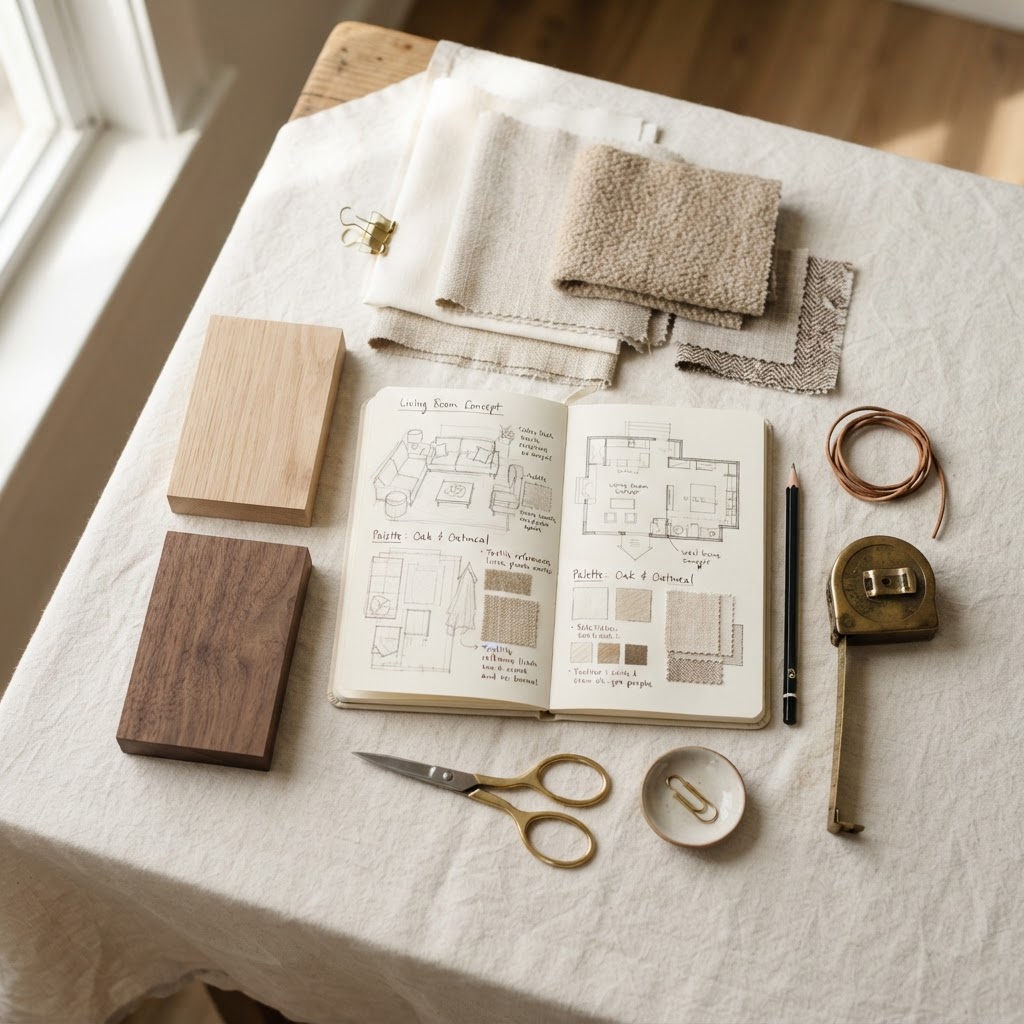
A piece can be beautiful on its own and still be wrong for your room.
Beyond the 5 M’s, a designer also weighs:
The last word
A better price is only part of the decision
You now know how to find a piece from a photo, trace it across stores, and compare what the listing won’t tell you. The real goal was never the discount — it’s choosing pieces that work together, sit at the right scale, and never turn into an expensive return. That’s the difference between buying furniture and designing a home.

“I built this guide from the same questions I ask on every client project — so you can shop with a designer’s eye before you ever call one.”

Need help choosing the right pieces for your space?
Comment or message the word ANA to learn how ANA'Studio can help you design, plan, and transform your home.
ANAApp features, store policies, prices, and delivery terms change frequently. Always confirm details directly with the platform or retailer before completing a purchase. Figures in this guide are illustrative examples, not current prices.
© 2026 ANA'Studio Interior Design. All rights reserved.